





Donna McFarland: Diagnosed with MS; Food Became My Medicine
In 1989 I was 32 years old. It had been two years since I had quit my 17-year smoking habit, and I had adopted a rigorous physical fitness regimen. I truly felt on top of the world, and nothing could stop me. In addition, having developed a greater level of self confidence, I began life as a student again at a local community college. All of these successes empowered me to continue striving and believing in myself, something that had not come easily to me before. This was an entirely new era for me. Little did I know, however, that the confidence that had blossomed within me would soon be tested.
To help curb my tobacco withdrawal cravings I had begun working out at a gym, and was surrounded by very strong, fit people. One such person was a former Marine drill instructor and Mr. World contender who became my personal coach. Each day, he would encourage and educate me about fitness. He made the experience fun for me: a new addiction had been spawned. During this time I was also learning how to make healthful dietary changes, and I did so gladly. Living in California at the time, with fresh produce not only abundant, but available year-round, helped making dietary changes easier. I had never felt so good in my entire life. What a revelation!
And then I woke up on April 17, 1989, one of the darkest, most life-altering days of my life. As I got out of bed I was shocked to find that my left leg collapsed under me. It felt heavy and would not support my weight. I erroneously passed it off as a pinched nerve. My doctor couldn’t find any cause for it, so it became a “watch and wait” situation. I dragged that leg around for more than six weeks. I continued to work out but was unknowingly worsening my condition every day. Almost as soon as this first symptom began to wane, a new symptom of tingling on the right side of my body began. More doctor visits and tests were ordered, but nothing was determined.
Following this I had roughly six weeks of very odd sensations on one side of my body that couldn’t be explained. While additional tests were conducted, I continued to believe it was all fairly harmless. How could anything bad be happening to me now? I was certainly on a high of optimism, so much so that I ignored all the signs (tingling, burning, fatigue) my body was giving me and continued my gym workouts. Nothing was going to stop me.
When the fourth symptom—very fuzzy eyesight in one eye—occurred, I was sent to an eye doctor. He diagnosed me with optic neuritis and suggested that I see a neurologist as soon as possible. My family doctor scheduled an appointment with a neurologist in Phoenix, Arizona at a well-known neurological institute. My doctor warned me ahead of time that the physician he was referring me to did not have a pleasant bedside manner but that he was very proficient in his field.
How can one hour, one day, change a person’s life so dramatically? The MRI was performed and the follow-up meeting with the neurologist went something like this: “The MRI shows that you have multiple sclerosis. You are among the top third of the worst cases we’ve ever seen here. You have a few good years left.” The neurologist delivered the news with as much compassion and sensitivity as a weatherman might deliver the day’s highs and lows. Talk about devastating! The fact that I had had four exacerbations within a five-month time frame further made for a dismal prognosis.
My mother had died of systemic Lupus at the age of 33, and here I was at 32 years old thinking, “I guess this is it.” When I asked if there were any dietary changes I could make to help my symptoms, an emphatic “No” was given. I was told that my exacerbations would be treated with high doses of steroids given in the hospital. Having watched my mother go through her agonizing decline, I wanted nothing to do with hospitals or doctors ever again.
Fortunately, within a short amount of time, I discovered Dr. Roy Swank, MD, Ph.D, the head professor of neurology at Oregon Health Sciences University. I learned that he had studied multiple sclerosis (MS) since 1946 and, based on his scientific findings, had successfully treated MS patients through a healthful diet. His track record and credentials were impeccable. I was truly fortunate that he was still practicing in his 70’s. As broken-spirited and emotionally shattered as I was when I first met Dr. Swank, his words to me were the most healing balm for the soul there was: “If you do as I say, Donna, you can live a normal life.” With those words he gave me back my life. I was a patient of his for the remaining ten years of his practice.
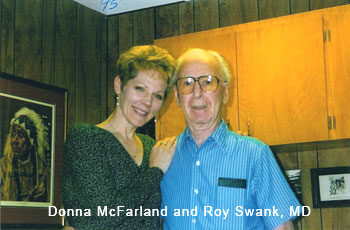 Hearing his success stories about controlling the progress of the disease through dietary measures was inspiring. I studied the program intensely. I ate a very low saturated fat diet (15 grams max a day) and ate lots of clean, whole foods. I didn’t look at it as a diet but as a lifestyle, one that I enthusiastically embraced. Also, to help reduce my symptoms, I was instructed not to do exercise that would overheat my body’s core temperature, and to reduce stress as much as possible while making time for daily rest breaks. As time passed in that first year, I not only regained all the functions that I’d lost, but I felt increasingly better.
No one can believe how this program has stabilized my health. When I share my story, most people want to hear the details, which I am happy to share. I feel that if I don’t talk about my journey at least once a day, I’m not doing my job. I now search out open-minded physicians—not closed-minded authoritarians—who will work with me as a partner in my health care. Nowadays when I learn that someone has been diagnosed with MS and put on a drug protocol, it saddens me greatly. Many patients are shattered, as I was after my diagnosis, and feel that they must follow their doctor’s advice. To them I say, okay, but incorporate a healthy diet as well. For every day lost, it’s going to be harder to regain ground.
Multiple sclerosis, a disease of the central nervous system, affects around 350,000 Americans (mostly Caucasians, and more often women than men). Its numbers are higher in populations where typical diets are comprised of beef, butter, cheese, and other saturated fats. The addition of so many trans-fats has also escalated numbers. MS is often treated with one of three or four very expensive and toxic drugs. Dr. Swank’s work, however, is completely nutrition-based and carries no dangerous side effects.
It’s been 18 years now since I first met with Dr. Swank, and today I do not use any kind of aids or devices (such as a walker, cane, or braces), but I do take the daily rest breaks that he strongly advised (to allow my body’s compromised nerves adequate time to rest and recover). I am grateful for each day of health that I enjoy, and only occasionally do I feel some extremity tingling (when I’ve allowed myself to overdo it without rest).
I volunteer at a local hospital and cook healthful and tasty meals for my very supportive husband and myself. Keeping to a simple diet of brown rice, legumes, fresh vegetables and fruits, as well as minimizing fats, has done a world of good. I also volunteer for the Swank foundation as a mentor, via email, to the people who find their way to the Swank program or to those who simply need a comforting, friendly ear.
To Dr. McDougall, a heartfelt “Thank you!” for your dedicated efforts to continue the work of Dr. Roy Swank. The legend lives on because of you. I’ve since adopted Dr. McDougall’s low-fat, plant-based diet as another layer to my health restoration and preservation. To quote Hippocrates, the Father of Medicine, “Let your food be your medicine and your medicine be your food.” This is certainly the message in the work of Dr. Swank and Dr. McDougall.
Note: Visit Dr. Swank’s website at http://www.swankmsdiet.org/
For more information see Hot Topics on Multiple Sclerosis.
Dr. McDougall’s Comments
 After cancer, multiple sclerosis is the diagnosis most people hope they never hear from their doctor. The course of this disease is very difficult to change and the outcomes are often dismal; as a result, doctors have told me that they try to avoid caring for people with MS—and after knowing the statistics, you will understand why. Even with the use of the most modern medications, costing $20,000 a year, the future prospect is: half of these patients are unable to walk unassisted, or are bedridden, or wheelchair bound or dead within 10 years of diagnosis.
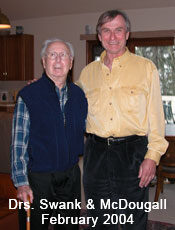
Fortunately, the future would be very different—like in Donna McFarland’s case—if doctors practiced sensible diet-based medicine. For more than 60 years the rich Western diet has been known to cause of MS, and for more than 50 years a low-fat, near vegetarian, diet has been known to arrest or cure MS. The principal discoverer of “the diet-MS connection” is Roy Swank, MD, former head of the University of Oregon Medical School Neurology Department (for 23 years), who has cared for over 5000 patients with MS during his career. More information about Dr. Swank
Dr. Swank wrote in 1959 in his book Low-fat Diet, “Gluttony and chronic degenerative diseases have been linked in the minds of both laymen and scientists for many years. The saying, ‘to dig your grave with your teeth’ probably has its origins in antiquity; but, in the prosperous areas of the Western world during the past few decades, the maxim has taken on real and tragic meaning.”
About 20 years ago, during one of my many visits with Dr. Swank at his Oregon Medical School office, I asked him, “Why is it that when MS patients ask their doctors about changing their diet, they are told this is quackery? And why does the MS Society offer a similar message? You have published in the world’s most respected journals that a simple, cost-free diet can stop this disease. Yet, they summarily dismiss you and your work.”
He leaned back in his chair, took a moment for thought, and then explained, “You know, most people in this country expect to be cured by a pill, and have a cure that is almost instantaneous. With the low-fat diet, the people actually have to work to get better, and have to cure themselves. And as far as the MS Society is concerned, John, they don’t mention it because they didn’t discover it. It wasn’t their research dollars that found this treatment. So they’re not going to tell anybody. I discovered it in my small office here, in the basement of the University of Oregon Medical School.”
So it is not just money that keeps people from highly effective dietary cures; egos are also involved—the well-known business doctrine, “Not Invented Here,” is working to keep you and your family sick. Self-centered people think, “If I didn’t invent it then there is no real reason for me to promote it, especially when there is no fame or fortune for me.”
The scientific research published by Dr. Swank shows that if this disease is detected early, by following a low-fat diet, there is a 95% chance of NOT dying of MS or its complications over the next 34 years.1 Even people who have had multiple sclerosis for a long time, and have already suffered severe damage, will slow the progression of their disease after a change to a low-fat diet. I once asked Dr. Swank, “When followed strictly, how often does the diet fail?” His answer was, “Only 1 in 200 people would not benefit.”
Dr. Swank is now 98 years-old; his pioneering work is left for a new generation of scientists to research, doctors to prescribe, and patients to follow. Over the past four years I have raised over $600,000 to start an investigation to prove the benefits of a low-fat diet for MS patients, using modern scientific tools (MRI scans and disability evaluations performed by neurologists). By doing research comparable to that used by the pharmaceutical companies to sell highly toxic, relatively ineffective drugs,2 I hope to show Dr. Swank was right all along, and change the way medicine is practiced.
References:
1) Swank RL, Dugan BB. Effect of low saturated fat diet in early and late cases of multiple sclerosis. Lancet. 1990 Jul 7;336(8706):37-9.
2) Pittock SJ. Interferon beta in multiple sclerosis: how much BENEFIT? Lancet. 2007 Aug 4;370(9585):363-4.
Recommended Articles
Melysa: Ticking Time Bomb Turned Off

Lars P. Lidberg: Painful Arthritis, Cholesterol
Join the Conversation!
Have a question, a helpful tip, or a story from your journey? Add it below - your voice matters.