


Robert Cross: Formerly Dying from Heart Disease
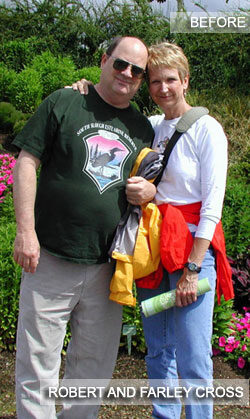
When my chest pains began I was in fairly typical health for a man of 61 years of age who eats the Standard American Diet. My body had gradually deteriorated over the years and I had become a frequent customer of doctors and pharmacists. Several times a day I swallowed pills for blood pressure, diabetes, cholesterol, and recurrent kidney stones. Worst of all, it seemed that every few months I needed higher doses of these medicines, and none of the lifestyle suggestions made by my doctors or the dieticians seemed to be doing me any good. I was resigned to watching my health deteriorate, while hoping that I would avoid the serious consequences that loomed on the horizon. My 250-pound body weight was another forecaster of the future soon to come.
Everything changed in January of 2008. I saw my doctor, an internist, for what I thought to be a flare up of my frequent indigestion, which I noticed particularly while kayaking. With the intensity of the pain and a history of a cholesterol level of 294 mg/dL (my LDL cholesterol was 210 mg/dL), my doctor insisted that I undergo an exercise nuclear heart scan—an indirect test of the blood flow to my heart and an indication of the presence of serious blockages in my heart arteries. I reluctantly agreed.
I knew that I was in trouble during the test because my “indigestion” got worse and the pain became more focused in my chest the faster I moved on the treadmill. I could not get my heart rate to the predicted maximum for my age because of the pain. I could only exercise for six minutes, and had to be injected with some medication in order to increase my heart rate to maximum. My pain went away very shortly after I got off the treadmill. I was not surprised, only depressed, when the results came back positive for coronary artery disease.
My internist referred me to a cardiologist, and explained that I would certainly be undergoing some type of surgical procedure—probably an angioplasty with a stent. Here are some quotes from that first report:
“Review of stress and rest myocardial perfusion images demonstrates a large region of mild-to-moderate perfusion deficit extending along the inferior and lateral walls at stress, not apparent at rest. There appears to be wall motion abnormality in the lateral wall at stress which appears less prominently during rest. . . . ABNORMAL MYOCARDIAL PERFUSION STUDY HIGHLY SUGGESTIVE OF REVERSIBLE ISCHEMIA IN THE LEFT CIRCUMFLEX TERRITORY.”
I was frightened and concerned for my wife and teenage son, who depended upon my love as well as my income. My fears were intensified because my dad had died of complications from bypass surgery. My cardiology appointment was still several weeks away, and in that time I researched everything that I could on the internet.
I learned of Dr. Esselstyn, who claimed that heart disease could be reversed. I was skeptical because I have a medical background myself and had never heard of such a claim. My wife bought a copy of his book, Prevent and Reverse Heart Disease, which contained very powerful evidence that heart disease could be reversed. I started the program that very day.
My blood was drawn on the day of my cardiology appointment, and the cardiologist recommended an angiogram (pictures of the arteries), which would probably be followed by an angioplasty and stent placement. He asked me to take Plavix and aspirin, which I would be on for life. He dismissed my questions about lifestyle and reversal.
Further research led me to Dr. McDougall, and registered dietitian Jeff Novick. All these people gave hope for arresting, and perhaps reversing, my condition through diet and lifestyle modifications. In contrast, neither my internist, nor my cardiologist, was aware of these doctors or their programs or any significant benefit to lifestyle modification. They discouraged me from delaying the surgery, but accepted my decision to at least give diet and “medical management” a try.
My early results were promising. My first blood test on the diet showed my cholesterol was now down to 120 mg/dL and my LDL was 60 mg/dL. My internist was astounded. Medication had only lowered my numbers slightly. I was on Dr. Esselstyn’s exact program, which is virtually identical to that of Dr. McDougall, and I hired the McDougall Program dietitian, Jeff Novick, RD, as my coach. I found that everything I needed was available immediately and for free through Dr. McDougall’s website. I learned that my results would directly reflect my compliance with the program. I resolved that I would do this program 100 percent. If I could not be 100 percent on my own or failed to get my doctors’ support, then I was going to go to the McDougall Live-in Program without delay. (I still plan on going.) I owed that to myself and my family.
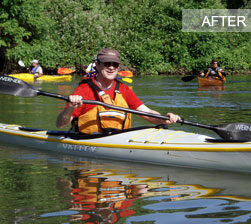
Almost immediately, my chest pain went away. My internist asked how I had accomplished this and my dramatic cholesterol drop, and then became quite interested in my program. I needed his help because of the side effects of the medications that occurred once I changed my diet. I had to quickly get off my blood pressure medications because my readings were extremely low and I was feeling light headed. My blood sugars came way down and I had to terminate my diabetes medication. I eventually stopped all of my Lipitor, yet my total cholesterol stayed at 160 mg/dL (my LDL cholesterol remained at 60 mg/dL). I have lost over 60 pounds since beginning my new diet and exercise program in January of 2008, and I continue to lose as my energy increases. I have had no more kidney stones.
After following my progress for almost a year and a half, the cardiologist wanted to repeat the nuclear heart scan. My internist agreed. He was also sure that I was wrong when I had told him that many clinical trials have shown no important benefits other than pain relief for the surgery they had proposed for me more than a year and a half ago. Despite my many obvious improvements, the cardiologist still believed that coronary artery disease is always progressive, and told me not to get my hopes up about the new test. I repeated the exercise nuclear heart scan on May 5, 2009.
This time, I felt great running on the treadmill. I took my heart rate beyond the maximum expected for my age, and had no pain. The monitors I was connected to indicated no problems. Immediately after the test, I spoke with my cardiologist, who seemed somewhat perplexed. He chose his words very carefully. He wanted to know if I had felt chest pain on the first exam in 2008. I think he did not believe the previous test results, because this time my heart showed only a single mild abnormality. Most noticeable was that the large area of obstruction found on my first test was not seen at all.
He seemed to not want to confront the possibility that the both tests were accurate—that I had actually reversed my serious condition with a simple change in diet and a little exercise. How could he question the obvious: my weight loss, the reductions in medications, and the changes in my blood pressure, blood sugar, and cholesterol levels? Right before his eyes I went from sick and symptomatic to feeling and looking great. His skepticism continued as he explained to me that despite the fact that the occlusion could no longer be seen, it did not mean that I was totally cured. But at least he now accepted my decision to avoid surgery as responsible.
Here are some excerpts from the cardiologist’s report of my second test: “He comes in today and underwent exercise myocardial perfusion imaging. He was able to exercise almost 10 minutes on the standard Bruce protocol. There were no reported symptoms consistent with angina pectoris. He denied chest pain or chest discomfort. (He denies any symptoms of congestive heart failure—shortness of breath and extreme fatigue).”
The myocardial perfusion images showed there was still a subtle inferior wall perfusion defect…[that is it]. My cardiologist’s recommendations: low dose aspirin and a nine-month follow up visit.
I look back on this lifestyle change as one of the most significant things I have ever done. The improvements have gone far beyond the reversal of the disease in my heart’s arteries. So many everyday problems have vanished – high blood pressure, diabetes, high lipids, indigestion, obesity, kidney stones, etc. More important, this is a treatment that I can feel and see. Before, those pills and my old diet made me look and feel awful. I now have a new lease on life.
 I am proud to be a Star McDougaller because I can share and help others. I would like everyone to have the same chance for health and happiness I have. But, there is really nothing “star-like” about me. I just follow Esselstyn’s, McDougall’s, and Novick’s recommendations. That is all it takes—it is so simple. Although it was not easy at first, I cannot imagine anyone who tried this program for 30 days, who would not decide that it is a far better way to eat and live than what is commonly called the Standard American Diet.
As a footnote, my internist recently referred a colleague of his, a surgeon, to me. The surgeon had similar problems to my own, and I invited him and his pathologist wife to dinner and a movie consisting of Dr. McDougall’s DVD’s. I recently received an email that he has dropped over 100 points off his cholesterol and LDL, and over 120 points off his fasting blood sugar, and is feeling great.
Robert Cross
Dr. McDougall’s Comments
Solid scientific support for the correct decision Robert Cross made in January of 2008, to refuse heart surgery, is in this week’s New England Journal of Medicine report on the BARI 2D Study Group. The intention of this research was to show that the early treatment of people with diabetes with heart surgery (angioplasty with stents or bypass) would result in a better chance of survival than from no surgery. The results were no benefit from surgery. Add this study to the long and consistent list of trials that show no survival benefits and tremendous harms to patients from aggressive medical interventions for coronary heart disease, and you must wonder why this approach continues essentially unchallenged.
Many of you ask why I (Dr. John McDougall) aggressively confront doctors who continue to practice “traditional medicine.” The reason is that almost all pharmaceutical and surgical treatments for chronic disease fail—and everybody in the “business” knows this but no one seems willing to do a thing to change the practice—and that is because there is too much money at stake.
The facts are not debatable—they are simply hidden from public awareness. Much of the dishonest reporting is done by spin-doctors. Spin-doctors are real MDs who have lost their moral compass, who work for vested interests—the pharmaceutical companies and themselves (heart surgeons and cardiologists).
Realize, I have so far mentioned nothing about diet or exercise. I am writing to you about prescriptions from your trusted doctors that do harm to people, and no one seems to be willing to right this wrong. These treatments are maiming and killing people who eat the standard American diet far more often than affecting you and me, who have taken corrective measures to stay well.
Now add this injury to the fact that almost no patient receives honest effective dietary advice from any doctor or dietitian, or any health organization. Some of you may think this is a conspiracy—but there is no conscious collective effort behind this injustice. This is just business as usual. Expect no change to take place until conservative care becomes more profitable than doing wrong. Or legislation, such as AB 1478, proposed in the state of California becomes law. This Assembly Bill will force physicians to tell their patients about the undisputable failures and harms from heart surgery and diabetes treatments. Plus, if I have my way, doctors will have to tell their patients about the miraculous benefits of a delicious starch-based diet. In the meantime you will have to protect yourself and your family by becoming educated like Robert did.
Recommended Articles
Jeanmarie: From Multiple Sclerosis to Complete Remission
Emily Overcame Disordered Eating, Recovered Her Health and Lost Weight