



Nat Cohen: Elderly Recover with Diet
July 6th will be Nat Cohen’s 87th birthday. Happy Birthday Nat!
 Story by Robert Cohen, founder of the Dairy Education Board and the Notmilk web site (www.notmilk.com). He is the author of Milk: The Deadly Poison and Milk A-Z.
My father lives in Oradell, NJ. He and my mother have been married for 55 years and I am one of their 2 children. During WW2 he built airplanes, but for most of his life he worked as a manufacturer of Ski wear. He has always been an avid sports fan. Before his stroke, he worked out every day at the health club – he was once a golden gloves boxer, semi-pro baseball player, championship handball player, and played racquetball until age 85.
My father suffered his first stroke in August of 2002. His second stroke occurred four months later; a few weeks before Christmas of 2002, and it was devastating. Both of dad’s attending physicians were family friends. His neurologist was in tears. She told me that he would probably not survive for more than a few days. His cardiologist expected that if dad was to miraculously survive, he would be totally disabled, unable to walk, talk, feed himself, or do any of the normal things that he did before his stroke. We discussed some very difficult quality of life issues and options.
I cooked every meal for dad during his one-month rehabilitation in a nursing home. Every one of their traditional dietitian-approved meals contained saturated animal fat – magic bullets I call “weapons of mass destruction.” Each of their meals had the potential to cause the same cardiovascular event that got dad to where he was. In a bed, he was unable to talk or walk. The vegan diet that I prepared each day was nurturing, but the critical factor regarding his return to health was not eating the dangerous foods that got him there in the first place.
The day after taking him home, I began to watch with him episode after episode of the McDougall tapes (Just released on DVD). At first, he thought his recovery was a long shot. Dr. McDougall and I both convinced dad that it would be a sure thing. That it was!
It’s one thing for a “son” to give fatherly-advice to own his dad. It’s another thing to have that same vegan advice reinforced by a physician. I give credit to Dr. John McDougall for extending my dad’s life. It’s been nearly seven months since the last stroke, and dad’s physical and cognitive skills improve daily. He beats mom in their daily scrabble games, and his memory is incredible. (We discuss every New York Yankee baseball game, and he can cite you up-to-date batting averages at any time).
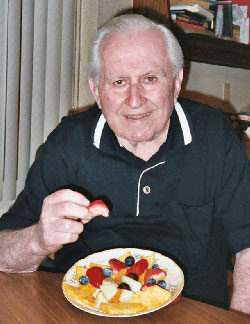
Dad also now loves his vegan diet. His favorite restaurant has become Veggie Heaven in Teaneck, New Jersey. Dad now adores each day’s large fruit salad. I call the components “vitamin pills.” He has learned to love veggie burgers, and makes his own soy milk. Dad has gone from walker to cane, and with me in the passenger seat, went for his first rehabilitation driving lesson in the deserted high school parking lot this past weekend. I was amazed at how good he did.
Dr. McDougall’s Comments:
Life is short enough, especially with all the efforts we and others make to cause it to be shorter and less enjoyable. Mr. Cohen has enjoyed a good life but he wants a few more good years – and so do we all. More than once I have heard my patients say, “If I had known I was going to live this long, I would have taken better care of myself.”
The conventional approach to the elderly is to medicate them. And the results are concerning:
- Analysis of medication use among elderly shows prescription drugs were used by 60-68% of men and 68-78% of women and nonprescription drugs were used by 52-68% of men and 64-76% of women.1 *
- The more doctors a patient has, the more drugs they will be taking.2
- The elderly take, on average, 2 to 4 kinds of prescription medications daily and the older they are the more they take.3
- Laxatives are a daily requirement for older people. This is no small matter (or is it?) In one study of elderly people, the average number of nursing interactions for constipation treatment was 23.3 per month.4 The average cost per day for care specifically for the treatment of constipation was $2.11.
- Sleeping pills are taken by 53% of the elderly. Prescription products accounted for 83%, and 17% of the products used were over-the-counter.5 Medications, such as sleeping pills and antidepressants, increase the risk of falls and fractures.6
- The pharmaceutical companies determine the medications the elderly take – which is far different than their real needs in most cases.7
The human body is an absolute miracle and it is never too late to support it with a better diet and exercise program. People in their nineties have started the McDougall Program and they always improve – most times the results have been dramatic. One of the first benefits (and much appreciated, by the way) from a change in diet is daily effortless bowel movements without laxatives. They lose excess unwanted weight. Medications for blood pressure and diabetes are as easily discontinued in the elderly as in younger persons – and the need to stop these medications is often much greater, because these people are much more sensitive to the side effects and the benefits are even more questionable.
The big pay backs for the elderly from regular exercise are great, and include: fewer medications, a reduction in risk of coronary heart disease, diabetes mellitus, hypertension and obesity as well as improvements in bone density, muscle mass, muscle strength and function.8 All this ultimately means an increase in physical activity and a greater opportunity to live independently with a higher quality of life.
Many concerned people who are trying to help their parents, like Robert and his father, Nat, contact me. My first comment to them is to never give up trying to help them. After all, they were always there for you when you needed their help. My second comment is that they will be amazed at the rapid improvements simple, cost-free approaches, like a low-fat, pure vegetarian diet and a walk can make for them. Today would be the right time to start sharing the good news about diet and better health with all the people you know – and especially those people who are, as they say, “enjoying their golden years.”
References:
1) Chrischilles EA. Use of medications by persons 65 and over: data from the established populations for epidemiologic studies of the elderly. J Gerontol. 1992 Sep;47(5):M137-44.
2) Walop W. Prescription and nonprescription drug use among at-risk community-dwelling seniors in Ottawa-Carleton. Can J Clin Pharmacol. 1999 Summer;6(2):93-100.
3) Anderson G. Distribution of prescription drug exposures in the elderly: description and implications. J Clin Epidemiol. 1996 Aug;49(8):929-35.
4) Pekmezaris R. The Cost of Chronic Constipation. J Am Med Dir Assoc. 2002 Jul-Aug;3(4):224-228.
5) Busto UE. Use of prescription and nonprescription hypnotics in a Canadian elderly population. Can J Clin Pharmacol. 2001 Winter;8(4):213-21.
6) Ullom-Minnich P. Prevention of osteoporosis and fractures. Am Fam Physician. 1999 Jul;60(1):194-202.
7) Kubesova H. The influence of new scientific information on the treatment of elderly patients in general practice. Acta Med Austriaca. 2001;28(2):52-5.
8) Mazzeo RS. Exercise prescription for the elderly: current recommendations. Sports Med. 2001;31(11):809-18.
Recommended Articles
Diane Weedling: Diet Freed Me from Lupus and Medical Specialists
Linda: Reversed Heart Disease, Pre-Diabetes and Lost 50 Pounds
Join the Conversation!
Have a question, a helpful tip, or a story from your journey? Add it below - your voice matters.