



Mary Splady: Standing up to the Osteoporosis Hype
 At age 53, in 2004, I had my first bone density scan and was diagnosed with osteopenia, the precursor of osteoporosis. For years I have been aware that my small 5’3″ build could be a risk factor for osteoporosis, and now it seemed my fears were finally being realized.
My doctor didn’t tell me that I had to take Fosamax, but she said that it would prevent further bone loss. By that point I had read a book called Selling Sickness: How the World’s Biggest Pharmaceutical Companies Are Turning Us All into Patients. The fact that osteoporosis seemed overly hyped by the pharmaceutical industry, along with my reluctance to take any medication, left me wary and uncomfortable. But, despite my instincts, I began taking Fosamax.
Many years prior, I had decided to become a vegetarian. I had also decided to stop drinking milk at every meal (in an effort to lose weight), but I continued to eat cheese and other dairy foods on a regular basis. I had never even considered eating pizza without cheese or a baked potato without sour cream and butter. I was eating an “osteoporosis-prevention” diet according to commonly held doctrine about dairy foods.
After becoming a vegetarian I also began taking lots of vitamins and supplements because I, along with my friends and family, was concerned that I would not be getting sufficient nutrients without meat in my diet (one of my supplements was a mega dose of minerals, including calcium). My parents thought for sure I would perish without red meat. I, too, wanted to make sure that I wasn’t doing myself any harm.
Later, after starting Fosamax, I began reading more about diet and health and learned about Dr. McDougall from my boyfriend, Bob Whelan. I decided to shift to a low-fat, low-sodium vegan diet in an effort to get off the Fosamax. In addition to my previous concerns, I often wondered why the advisory about this drug warned against lying down when taking it—what was that stuff doing in my body?
So I stopped taking Fosamax after a couple of months, as well as all my vitamins and supplements, including the calcium. However, I was still concerned due to all the media hype about osteoporosis, so I emailed Dr. McDougall. In addition to providing me with some literature on osteoporosis that supported my decision to discontinue Fosamax, he assured me that, given my current diet and lifestyle, I would be fine without it.
At age 55, in 2006, I had my second bone scan, which clearly showed that my bone density had improved. Although the improvement was slight, it was very significant to me. I was thrilled and encouraged. I continued with my diet and exercise routine, and felt confident to be on the right track, finally.
Bob and I later attended a McDougall weekend workshop in Santa Rosa to continue our education. It was a fascinating experience and helped us strengthen our commitment to a healthy diet. When I met Bob, we were both vegetarian and physically fit, but over the past five years we have both further modified our diets and our exercise routines, supporting each other in our individual quests for optimal health. Committing to a low-fat, low-sodium vegan diet, helped Bob lose 40 pounds in about five months, and he has kept it off for several years now. He was also able to discontinue his blood pressure medication and now only needs a small dose of diuretic.
I also read The China Study by T. Colin Campbell. This enlightening book provided additional reassurance that dairy products were not necessary, or even desirable, for good health. The book cites correlations between populations that eat a lot of dairy and increased incidences of multiple sclerosis. The book also notes higher incidences of hip fractures in countries where women consume a lot of dairy products.
In addition, Campbell discusses the consumption of animal proteins and how they affect one’s ability to properly utilize calcium (and actually leach the calcium from the bones). So, meat and dairy in combination is “a dietary double jeopardy”. It is striking that in China osteoporosis is practically unheard of, and most people, until recently, have consumed little or no dairy. (They certainly aren’t taking supplements and Fosamax, either.)
Taking Responsibility
I think that our society in general wants the “quick fix.” People don’t want to take personal responsibility for their own health if it involves more than the slightest effort. I made a lifestyle change, and it requires daily choices: I choose to eat right, I choose to exercise, and I choose to educate myself.
People often tell me that they could not do what I do because they love to eat. Well, I really love to eat too, and that is what first led me to become vegetarian, then vegan. In counting calories, I quickly figured out that I would rather eat a big bowl of cauliflower than a small piece of meat. It is really quite simple: Vegetables are not as calorie dense, and therefore I can eat more of them.
Practically everything I buy at the grocery store now can be found in the produce and health food sections. With the aid of several McDougall cookbooks, the meals we prepare are easy and delicious. In fact, we love our own simple, home-made meals so much that we seldom eat out. We do try new products, but if something is not flavorful we don’t buy it again—we love to eat too much to waste our calories on tasteless foods.
We eat lots of vegetables and stick to whole grain breads and pastas. Non-fat hummus is our favorite bread spread. We follow the processed food buying rules we learned at the McDougall workshop: No more than 10% of calories per serving should be fat calories and the milligrams of sodium per serving should be very close to, or less than, the number of calories per serving. We can now tell at a glance if an item meets our criteria. We avoid all milk and dairy products, including caseins (milk proteins) and seek out food items that do not contain any added oil.
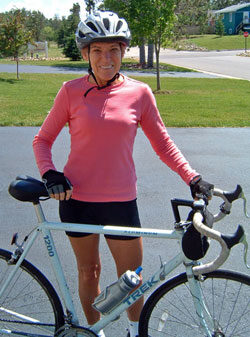
I work out on an elliptical glider almost every day for 20 minutes and lift weights three times a week. I also enjoy recreational workouts like bike riding and cross-country skiing. In a couple of weeks I will be participating in a 50-mile bike ride. I intend to continue this level of activity for many years to come, as exercise has been shown to be very important in maintaining bone health.
Follow-up
In 2008, at age 57, I had another bone scan, and my hip is now at 101% for women my age, and my spine has improved as well: There has been a 6% improvement in the hip and a 3.6% improvement in the spine over the past two years. There can be no doubt that I am rebuilding bone without medication, dairy products, or supplements. My diet also gives me the bonus of no cholesterol and being able to maintain a healthy weight.
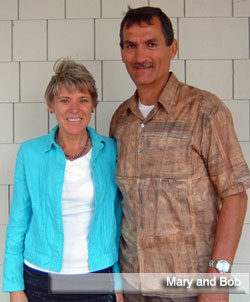 Today I am 5’3″ and weigh 109 pounds. Lest you think this is a skimpy diet, Bob is a former national-champion heavyweight wrestler. He is 6’2″ and weighs a healthy 195 pounds. We both eat as much as we want and are never hungry. I feel terrific, and I no longer worry about osteoporosis. I love that I am in control of my own health. I tell people that I intend to live to the age of 120, so at 57 I am not even middle-aged yet! Of course, I want all of those years to be healthy and active.
To those who ask about me about osteoporosis, I say keep an open mind and take charge of your own wellbeing. Quit hoping for the quick fix and learn healthy lifetime habits. Bob has a favorite quote: “I will do today what others will not do, so that tomorrow I can do what others cannot do.” We are doing it today and everyday!
Mary Splady
Bemidji, MN
July 2008
Dr. McDougall’s Comments
A person’s bones were meant to last a lifetime (about 85 functional years—some people live longer for better or worse). Bones age quicker when poorly nourished. An animal-food based diet lacks minerals (for example, meat has essentially no calcium and too little potassium, and dairy products have no iron) and vitamins (one example: meat, poultry, and dairy are totally deficient in vitamin C).
Animal foods are sold to the consumer because they are high in protein—proteins are made of amino acids. Very acidic amino acids, known as sulfur-containing amino acids, are abundant in animal foods. The net effect is; consuming a diet focused on meat, poultry, fish, seafood, eggs, and /or cheese results in the intake of heavy loads of acid at three or more meals a day. The body must neutralize all this extra acid; and the primary “buffering system” of the body is the bones. Over many years, the bones are destroyed in the process of releasing alkaline structural materials in an attempt to neutralize these excess dietary acids. Fruits and vegetables are alkaline.* Consuming these plant foods reverses bone loss, and thereby osteoporosis and osteopenia can be cured—as Mary and many other people with bone loss have discovered. Exercise has been proven to reverse bone loss.
There is no financial incentive to teach the above message. However, there are great profits in bone mineral tests, calcium supplements, and drugs like HRT and bisphosphonates (Fosamax, Actonel and Boniva). Even though HRT (estrogen with progestin) does build bones, these drugs have recently lost favor because they have been shown to increase the risk of developing breast and uterine cancer, and heart disease and strokes. For this reason, very expensive bisphosphonates are now the number one prescribed treatment for osteoporosis and osteopenia. I will not prescribe this class of drugs because they do very little to prevent fractures, and have terrible side effects, including, gastritis, esophagitis, bone necrosis, failure of fractures to heal, heart disease (atrial fibrillation), and severe bone, joint, and muscle pain. (I do on rare occasions prescribe estrogen with proges terone for osteoporosis.)
The BMD (bone mineral density) test is a flawed measurement that gets most women “hooked” on a lifetime of drug therapy. This test uses the amount of mineral commonly found in the bones of a young woman as the “normal” value. A woman stores large amounts of calcium and other minerals in her bones during her reproductive years in order to provide for the development of her fetus and nursing infant. In post-reproductive years she no longer has this biologic need. This reserve of minerals is naturally lost, and the BMD lessens—this is a normal process, not a disease. The supporting structural bone materials should remain healthy and strong during this mid-life change. But they often don’t for women burdened by the high-acid, high-animal protein Western diet.
Now that you understand that the extra mineral in the bone is to provide for reproductive needs, and has little to do with bone strength, you now understand why the correlation between BMD and fracture risk is very poor. Because of the limited predictive value of the BMD test most non-pharmaceutical-funded health organizations recommend against routine screening of women using BMD tests. However, the reason almost all women and their doctors believe otherwise is because big money from the drug industry controls most of the information they receive from research, advertising, and the, supposedly legitimate, media. You can learn more by reading from my Hot Topics osteoporosis. Also read this important article: Drugs for pre-osteoporosis: prevention or disease mongering? BMJ. 2008 Jan 19;336(7636):126-9.
*Legumes and grains are slightly acidic and should be limited in a diet intended to optimally alkalinize the body. Meals from the McDougall Diet that contain these ingredients are, overall, alkaline because they also contain plentiful amounts of fruits and vegetables. Consider; cheese is 10 times more acidic than beans or wheat—beef 6 times, chicken 7 times, and fish 9 times more acidic.
Recommended Articles
Fran Myers: Discovered the Starch Solution, Lost weight, Now Pain Free
The Four of Us Agree: “It’s the Food®”
Join the Conversation!
Have a question, a helpful tip, or a story from your journey? Add it below - your voice matters.