



June Ziegler: Depression, Heart Disease, Overweight
A Psychological War for Enduring Health
 I was dying and I couldn’t save myself no matter how hard I tried. My wanting to eat healthy was always there – forefront in my mind — but my “old foods – the ones mommy used to cook for me,” kept calling out to me. “Eat me and you will feel better.” “You deserve more comfort.” When I was depressed, things got especially bad. I found fleeting relief in my old familiar foods – until I realized what I had just done to myself. I knew intellectually, my choices would make me even sicker, which would make me even more depressed – it was like a spinning circle that just kept getting deeper and more out of control. I felt so guilty for failing to eat the way I knew I should. The sadder I felt, the worse things got. And I gave up for awhile.
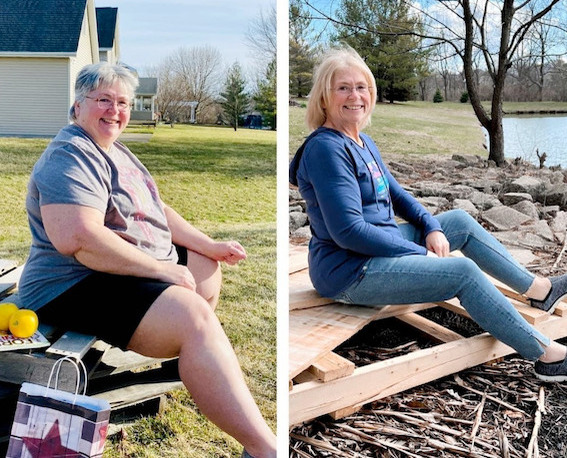
I was born and raised in Wisconsin – that is where I still have my friends and most of my family. The food from my childhood that makes me feel best is fried pork chops, and my 2nd favorite is deep fried fish on Friday nights, even though I’m not Catholic. I was trim at 118 pounds until I started gaining weight with my last child in 1974. I was diagnosed as hypothyroid in 1984 – but correcting that problem (and excuse) didn’t slow my weight gain. By 1987 I was 175 pounds and was looking for help at NutriSystems. My blood pressure, cholesterol, and triglycerides were on the rise too.
I didn’t start feeling that I was really sick until 1997 when I had heart trouble. Fred, my husband, and I were about to leave on vacation when I started feeling short of breath. We went to Mayo Clinic where they did a treadmill test (TST) – I flunked it; so they did an angiogram and found a 95% blockage. For the first time in my life I was very afraid of dying. The doctors talked me into an angioplasty (heart surgery). After they put a stent in my artery I felt terrible – I think it was the medications they put me on – it took me 3 to 4 weeks to recover – I felt really weak, light-headed, confused and bleary-eyed. I was afraid to go out of the house. I was told this was a progressive disease and I would be back for more surgery in 3 years. I was afraid for Fred to go out of the house, because I was scared I was going to have a heart attack and die. I spent a year depressed and tied up in knots.
I learned a lot about better eating from my children. My oldest daughter has been a vegetarian since age 23. My youngest son’s been a vegan (no animal products) since age 18. My oldest son eats well too, and was a vegetarian once. You might ask, “So why did I eat so poorly, with these great examples all around me?” I guess I wasn’t ready to give up my old favorites. My reaction to their “vegetarian eating” was; I cooked their favorite vegetarian dishes for them because I didn’t want my kids to go hungry; but I cooked the way my mother cooked for me – I cooked two meals.
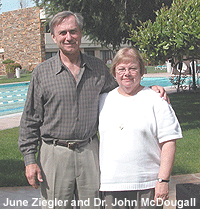
Out of desperation, I went to the bookstore looking for something or someone who could help me with my heart disease. I found Dr. McDougall’s book, The McDougall Program – 12 Days to Dynamic Health. It talked about reversing heart disease. Wow, that was just what I was looking for! I read the book from cover to cover and wondered if it really was true and if it would work for me. In the fall of 1998 I went to the residential McDougall Program and loved it. I was impressed with Dr. McDougall, his staff and all the care and information that they gave me. After the program, I felt better physically and for the first time since my Angioplasty, I felt hopeful. Upon my return home I did well – stuck with the program and lost 30 pounds. Then, to my dismay, I slowly slipped back into my old habits and the typical American diet.
We moved to California in January of 1999. This is where Fred wanted to retire — he wanted to be warm and to golf. I liked to golf too. I was depressed because I missed my home in Wisconsin and my family, and I slowly slipped into a cycle of deeper depression – using foods as a friend and comforter. Fred felt very sad for me because I was always in pain. He missed me too – there were so many things we wanted to do in our retirement, but I couldn’t do them – like hiking, golf, travel, and playing with grandchildren.
I regained my lost weight and in January of 2000 needed a second heart procedure (angioplasty). After the surgery, I continued to eat my favorite comfort foods spiraling ever downward, getting sicker and sicker. My legs were in almost constant, severe pain – I couldn’t walk – I had muscle cramps all over my body. I spent most of my days just lying on the couch watching television, wishing that I felt healthy and strong like my husband. Christmas of 2001 we went to Washington. DC to visit my daughter – the family visited our national treasures up close – I couldn’t walk, so they had to cart me around in a taxi. My daughter worried about me and would ask, “Mom, What are you eating?” I wanted to be able to travel with my husband, play golf, go on hikes and most of all; I wanted to be able to play with my grandchildren.
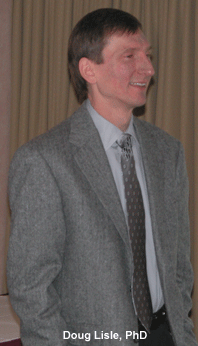 In December of 2002 I called Dr. McDougall on the phone and he introduced me to Dr. Doug Lisle, PhD (the McDougall Program Psychologist). He changed my life with these words: “If you get off track, don’t panic or give up. Just get back on – immediately. If you get stalled or stuck, CALL US! Get some help! This is a challenge, but you CAN do this program!” He explained to me how we are programmed for the “easy food.” He taught me how to navigate around eating out and at a party – he taught me non-threatening ways to deal with people. Someone like me who has a problem with food addiction really needs someone like Doug – he has been an enormous help. I am not perfect, but I know what I am supposed to do and I get right back to it the very next meal. Most important, with my new knowledge and attitude, I get better at taking care of myself every week.
In January of 2003 I returned for the McDougall Program in Santa Rosa, California. One of the most helpful things for me was the Psychology lectures by Dr. Doug Lisle on how to deal with food cravings and social situations. Dr. McDougall immediately took me off most of my drugs and within four days my muscle cramps disappeared and my leg pain began to improve. At the beginning of the ten-day program I was not able to join in the exercise program because I had very little strength or stamina. I would get short of breath just walking from my room to the lectures. Within 4 days the muscle cramps and pain stopped in my legs. In 10 days I lost 4 pounds. By the end of the program I was feeling much better – most importantly, I had the hope that I could recover – with a little effort on my part.
It has been eight weeks since I was in Santa Rosa at the McDougall Program. I have lost fifteen pounds, regained my mobility and feel better than I have in years. My leg pain is gone and I am now able to exercise. Since I have been home I have golfed twice – with lots of walking. My exercise routine consists of walking on the treadmill, riding the stationary bike and weight training. My eyes are less blurry and I have returned to my previous eye-glass prescription. My blood sugar went from 132 to 107 mg/dl and cholesterol from 184 to 179 mg/dl in 10 days. My blood pressure is near normal (140 – 150/70 mmHg), even after stopping one of my blood pressure medications (Zestril). I stopped my Prilosec; my indigestion is all gone. I have energy I once only dreamed of.
I have only just begun my journey back to health, but I wanted to share my story with all of you who don’t believe you can get better. Dr. McDougall calls me his “Rising Star McDougaller.” Think about what you can accomplish, like I have, in just 2 months. As I travel toward my goal, I plan to return to the McDougall Program for reinforcement and tune-ups from time to time. BTW, I’m leaving in a week and a half to visit the grandchildren. – I am thrilled! At age 60 years, I have no doubts about my future, because I am committed to work for it and I have all the support I need now – as Dr. Doug has told me, “Anytime it feels like the wheels might be coming off, just call me.”
The rest of my story is to be continued…
Dr. McDougall’s Comments:
You Have Much More Than Bad Eating Habits
98% of the people I meet tell me they have “bad eating habits.” And therein lies the problem. They think of their troubled relationship with food as “a simple little habit” – rather than a “life-destroying addiction.” In reality, this is a behavior that causes pain and suffering greater than tobacco addition, alcoholism, and heroin dependence. Eating the wrong kinds of food is the leading cause of death and disability in the Western world – obesity, acne, heart attacks, strokes, diabetes, arthritis, stomach pains, headaches, and constipation, to name a few problems. Yet, we treat food like a “lily white habit.” After all everyone eats the rich Western diet; even doctors, dietitians, chefs, policemen, and ministers eat it. Thin, apparently healthy people do, too. It is served in hospitals, schools, restaurants, and the nicest homes, worldwide. How could something so ubiquitously accepted – the rich Western food – be a problem deserving the respect of heroin, alcohol and tobacco?
One major difference between food, and alcohol, tobacco, and heroin, is that most people – those not under the influence of these substances – can see the insanity in these disreputable drugs. However, the actual users or abusers of these substances are rarely free to see the harmful effects of their addictions. Think about the almost insurmountable obstacle that would confront a person surrounded only by addicts to tobacco, alcohol, and heroin. They might actually consider their behavior normal and not see any need to change. Unfortunately, when it comes to food, 99.999% of the population living in developed societies is caught up in this damaging behavior – almost no one can see clearly – making it especially hard for someone wanting to “kick the habit” and become healthy.
In addition to the overpowering influence of friends and family, there is brainwashing from advertising by the food industry – an industry many thousands of times greater in influence than the ones pushing alcohol and tobacco. What do you find on the supermarket shelves? – Junk, junk and more junk. Not to mention the challenges from menus in almost every restaurant and fast food eatery. But, those willing to mount the proper degree of effort can out-maneuver these land mines, too.
Addicts are slaves to powerful substances that they cannot leave alone even though it wrecks havoc in their lives and for those loved ones all around them. They are in denial and part of this denial is that they cannot admit that they are out of control. The key to solving uncontrolled battles with food is to recognize the real power it has. Just like an alcoholic in a 12-step program must admit, “…we were powerless over alcohol – that our lives had become unmanageable,” so must people overpowered by food make this admission. Ask any cigarette smoker how they quit. They were never successful while thinking they had a habit. They will tell you success came from putting every single ounce of energy they could muster up against this monkey on their back. So if you want to win your battle over food you must muster that same energy – stop thinking you have merely “bad eating habits.”
Why is Food Addicting?
Only some of the substances we eat, breathe, or drink cause uncontrollable dependence. Nicotine-filled air is addicting, not clean air. Alcohol-laden water, not pure water causes alcoholism. Not all food is addicting – just “rich food.” Rich foods were once eaten by only wealthy people. Do you know what the kings and queens of olden time ate? Roast beef, pheasants, cheeses, pies, cakes and candies. Have you seen pictures of these people in art museums? What do they look like? Fat and sick. Now, billions of people – the monetarily rich and poor alike – living today in developed societies eat the same kinds of foods, and look and suffer the same.
There are many physical and chemical qualities of these foods that cause dependence, obesity, and poor health. For example, both dietary fiber and carbohydrate function to satisfy the hunger drive. These vital components are deficient in the rich diet, so people never stop craving them – they are constantly searching for the missing ingredients.
Rich foods hijack the pleasure system in the same manner as do drugs. These foods are another version of the same trap – and in this case, almost everyone is in it. Rich foods cause changes in brain chemistry similar to those seen with tobacco, alcohol and heroin addiction. Dopamine is a pleasure-giving substance released in the brain. Addictive substances release excessive amounts of this substance – causing us to crave even more. Desire for more of this pleasure-giving brain chemical leads to dependency.
There are clean foods – just like clean air and water – that work properly with our well-designed body. These foods are unrefined starchy vegetables (like rice, potatoes, corn, beans, and pastas), fruits, and green and yellow vegetables. If our diet consists of these foods both our bodies and minds are being treated in the way they were designed to be treated – and better health and well being are the result.
The lessons learned from this comparison of foods and addictive drugs are:
1) You don’t have to give up eating – just like you don’t give up breathing to quit tobacco or drinking to stop alcohol. You just stop eating the “dependency-creating” foods – the rich foods.
2) You must transform yourself with an “attitude for permanent change.” Most people looking to lose weight go on a diet to lose an extra 20 pounds and then return to their “normal” way of eating. This almost never works and that’s why 95% of people regain their lost weight within a year. Can you imagine an alcoholic saying, “I will stop drinking long enough to get my liver to stop hurting and then I will go back to my normal drinking?” You are not going on a diet – you are learning a new way to live, for your entire lifetime.
3) One bite could return you to ruin. Every reformed cigarette smoker will tell you their worst nightmare is to start smoking again. And we all know that it only takes one cigarette to get us back to 2 packs a day, effortlessly. You are probably the same with food. One bite of pie and you can’t stop – one buffet to the next – until you’re dead. So now that you realize this fact – don’t take that next bite. Act like every reformed alcoholic who knows it is one dry day at a time. But, if you get off track – stop immediately – count your blessings – and get right back on.
Change Your Behavior Today
Remember the famous quote from our former first lady, Nancy Reagan, “Just Say No!” This simple rule is crucial to success. Make the decision – I do not want to be the person I am (fat, sick, medication dependent, lethargic, incapacitated, etc.). I want my health and personal appearance back. Making this decision is the hardest part of permanent change – once made, however; then the rest of the battle is comparatively easy.
Ten Steps to Success:
1) Recognize that you are worth the effort – you deserve the best life possible.
2) Make a list of the personal reasons you want to change. Repeat that list over and over again in your mind.
3) Remove obstacles to change – like avoiding friends and family who sabotage you and removing junk food from your surroundings.
4) Surround yourself with healthy foods – stock your kitchen right, find an accommodating restaurant.
5) Commit yourself to change – pick the specific day and do it.
6) Gather all of your strength – everything else in your life must be secondary to this effort.
7) Never give in to the old ways – not even once. But, if you make a mistake – it’s only one meal – start right in again.
8) Tell others about your changes – they will help keep you on track.
9) Associate with like minded people – find friends with good habits.
10) Appreciate your success for beating the most powerful devils in your life.
Recommended Articles
Melysa: Ticking Time Bomb Turned Off
Jeanmarie: From Multiple Sclerosis to Complete Remission
Join the Conversation!
Have a question, a helpful tip, or a story from your journey? Add it below - your voice matters.