




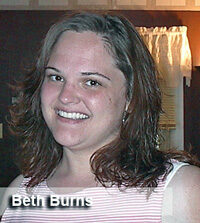
Beth Burns: Goodbye to Migraines!
 I started having migraine headaches when I was four years old. My mom called them “hungry headaches,” and every time I got one she fed me. I quickly learned to associate food with easing my pain. The problem, though, was that eating never made my headaches go away. I would continue to cry in pain, which only made things worse.
While growing up in Michigan, my dad struggled throughout most of my childhood to find work to provide for our family of seven. My mom was always a loving person, and giving and serving is how she showed her love to us kids. Since we didn’t have money for the things other kids had, my mom gave to us by baking and cooking. She was really good at it, and I was really good at eating whatever she made. If we said we didn’t like something or if we said we were full, you could see the pain on her face. So I ate everything.
I can remember my mom’s can of fat on the back of the stove. She would save the drippings from the meats she cooked for the evening meal (hamburgers, bacon, pork chops) and would use it the next day to fry the eggs for breakfast. Thursdays were baking day, and all that fat on the stove would go into mom’s cookies, cakes, breads and pies.
Although my mom did what she could to serve her family, she spent much of my childhood in bed. It seems like her head hurt all the time. I can remember she would often ask me to bring her a handful of aspirin—literally a handful. While the other kids in the neighborhood were running and playing outdoors, I, like my mom, was often lying in a dark room with an icepack on my head. Each of my migraines ended with violent vomiting and then several hours of exhausted sleep.
When I was twelve years old I contracted meningitis, the symptoms of which were very similar to what I experienced during my headaches. My parents didn’t realize I was sick because they were so used to me being in pain from the headaches. By the time my dad decided to take me to the emergency room, I almost died. I spent a week in the hospital suffering from severe pain, dehydration and hallucinations.
Alone with the pain
In school, even though I was academically advanced, my teachers often accused me of using headaches to get out of doing my work and to avoid participation in gym class. The truth is, I loved to run and play, it was just so hard to do with an almost constant headache. My siblings accused me in the same way, saying it was convenient for me to have a headache whenever it was time for chores (although, I have to admit, I liked getting out of chores).
By 10th grade my headaches were a daily event. I was taking prescription narcotics and had to have my teachers’ permission to be in their classes. It didn’t matter that I pulled straight A’s, the school secretary would still roll her eyes every time I asked to go home because of a headache. In college my migraines grew even worse. While the campus doctor told me that “some people are just prone to headaches”—a very discouraging comment—some of my professors were worried that there might be something else wrong besides “just migraines,” as if that’s not enough.
My heart was broken, and I lost hope of ever being normal. From this point I started a long trip down the road of depression. I didn’t want to get out of bed for class. I didn’t want to participate in campus activities. I didn’t even want to live. And by now, it wasn’t just the migraine pain that was out of control, so was my eating.
After college, when I started my career as a Worship Pastor, I decided it was time to take control of my migraine pain. After dozens of doctor visits, tests and drugs, I still had migraines at least three times a week. I also developed gastro-intestinal issues, such as constipation, diarrhea and acid reflux, which were thought to be the result of all the medications over so many years. My doctor also suggested I was allergic to tomatoes, wheat and garlic, so I cut these things out of my diet, plus sugar and caffeine. But I still continued to have migraines.
On two separate occasions I was in a serious dating relationship that was headed toward marriage. Both men, however, felt that they couldn’t commit to someone who may or may not ever be free of the migraine pain. By this time my depression was affecting my work and it was suggested that I seek counseling, which I did. My migraines improved somewhat but I still had one or two a week. If you’ve ever had a migraine headache you know that even one is too many.
I eventually got a job as a counselor in that same office. But I hated that clients were counting on me to help them with their problems; meanwhile I would often have to cancel appointments because my head hurt so much. At this point, it was clear that migraines controlled my life, not me. I spent a lot of money going in for shots to help relieve the pain when I just couldn’t bear it any longer. But generally I resigned myself to the pain and decided not to fight it so hard anymore.
Finally, relief
In addition to living with migraines, I also wanted to lose some weight. One day while talking to a friend about how I wanted to eat healthier in order to shed some pounds, she recommended The McDougall Program and gave me The McDougall Quick and Easy Cookbook. After reading the book and some other information from the McDougall website, I decided it was not going to work because everyone else out there (the media, other health authorities and authors, etc.) was saying that carbohydrates are bad. I figured I would just get fatter.
But I started following the program anyway because my friend had been so nice to give me the book. I kept telling myself, “It’s only 12 days—if it doesn’t work I can stop.” The funny thing is, my migraines disappeared! I also began to lose weight, especially after reading The McDougall Program for Maximum Weight Loss.
Within a week, because my blood pressure was so low (in other words it was now normal), I had to stop taking the beta blocker my doctor had prescribed as a migraine preventative. My migraines became fewer and farther between. They appeared once a week, once a month, once in a while, and then they completely disappeared. The last time I had a migraine headache was October 2006 when I was 31 years old. GI problems became a thing of the past, and I was able to eat tomatoes and wheat (although garlic still disagrees with me).
On and off the wagon
In November 2007 my mom died unexpectedly from Coronary Artery Atherosclerosis. At this time I had gotten away from eating McDougall style for various reasons and was starting to see a return of the headaches, although they were not yet migraines. My mom was only 64. Sitting at her funeral I realized that if I continued in my mom’s footsteps, at 32 years old I have already lived half of my life. That was a sobering thought.
So I explored other diet programs that allowed for the consumption of meat and dairy (I missed them) and, once again, daily headaches became routine. But I kept going because, after all, they weren’t migraines. In May 2008 I had my first migraine headache in almost two years. It scared me enough to bring me back to eating McDougall style. Within two weeks I was once again free of migraines. So what if I miss meat and dairy; it’s better than returning to a life of migraine pain.
I now take no cholesterol meds, no blood pressure meds and, most importantly, no headache meds! Now I can hike, bike, walk, travel, work, read and go to the movies. All of the things that used to trigger migraines are the things I now enjoy the most.
My advice to others who are looking for change is to just try the McDougall diet for 12 days; even if you have to tell yourself the same thing I did: “It’s only 12 days—if it doesn’t work I can stop.” But once the 12 days are up you will probably not want to stop.
Don’t worry if you fall off the wagon, you’ll eventually get sick of feeling sick and won’t care about missing the taste of meat and dairy foods. You will discover a host of new fruits, vegetables, grains and spices while still being able to enjoy healthier and delicious versions of your old favorite dishes, such as spaghetti and baked potatoes.
Before, on the standard American diet, I never felt full until I was so stuffed I felt sick. But on the McDougall diet I finally know what satisfied feels like, and it feels good!
Beth Burns
Saranac, Michigan
June 2008
Dr. McDougall’s Comments
Beth’s headaches ruled her life. We can only guess how different her childhood and early adult years would have been if she had, instead, lived pain-free. After searching and experimenting she has found a way to cure her migraines and improve her overall health—and it is a cost-free and side-effect-free method.
About 28 million Americans suffer from disabling headaches. When the pain is very severe, they are often called migraines—whether or not they truly are. Classically this kind of headache is preceded by characteristic symptoms called an aura. The aura is commonly visual disturbances, described as zig-zag lines and impairment of vision, but numbness and tingling of the face and arms, and speech disturbances also occur. These symptoms develop over a few minutes, usually last for less than 1 hour, and disappear before the headache begins. The headache pain is intense and throbbing and usually restricted to one side of the head—and lasting from minutes to days. The brain tissue has no pain fibers, but the blood vessels to the brain do have these sensory nerves. The migraine aura is believed to be caused by constriction of the blood vessels in the brain (cerebral vasoconstriction) and the headache by the dilation of the blood vessels that follows (reactive vasodilatation).
Worldwide, migraine headaches are reported more commonly in countries where people consume the Western diet.1 Obesity is also associated with the frequency and severity of migraines.2 These observations have led to the idea that rich foods play an important role in migraine headaches. As with many Western diseases (type-2 diabetes, heart disease, etc.), the large amount of fat people consume is suspect, and for good reason. Saturated fat (animal fat) causes blood-clotting elements called platelets to aggregate, and causes the activation of tiny hormones called prostaglandins. These fat-induced changes constrict and dilate the blood vessels.
A low-fat diet treatment used at Loma Linda University has been found to be highly effective for migraine sufferers. In their published study, 54 patients were taught a diet containing 20 grams of fat.3 There was no calorie restriction and the diet was primarily made of fruits, vegetables, grains, and legumes, in other words, a low-fat, vegan, diet. Their daily fat intake actually decreased among participants from an average of 66 grams to 28 grams daily. The results reported after 4 weeks on the diet were statistically significant decreases in headache frequency, intensity, duration, and medication use.
In addition to changes in fat content, there are other reasons a plant-based diet, like the McDougall diet, may help people with migraine headaches. Since 1913, allergic reactions have been found to cause migraine headaches in children and adults. Treatments with simple diets that avoid foods known to commonly cause allergies, such as dairy, wheat, and corn, have been highly effective at providing relief.4-6 (If the basic McDougall diet without wheat and corn fails to give relief then a highly effective elimination diet, found in my December 2002 newsletter, should be tried before food is discounted.)
Most people suffer from pain in the head area, but rarely do they make a connection between their headache and their food—other than the well-recognized sufferings that result from too much alcohol and caffeine withdrawal. Since diet has such a profound effect on every part of the body, food should be carefully looked at early on when the cause of headaches is being investigated. The benefits of a change in diet are not limited to migraine patients. I usually see complete relief of headaches of most kinds—even those with no name or identified cause—within days after a change in diet. So as Beth says, “just try the McDougall diet for 12 days.”
1) Morillo LE. Migraine headache. Am Fam Physician. 2002 May 1;65(9):1871-3.
2) Bigal ME, Liberman JN, Lipton RB. Obesity and migraine: a population study. Neurology. 2006 Feb 28;66(4):545-50.
3) Bic Z, Blix GG, Hopp HP, Leslie FM, Schell MJ. The influence of a low-fat diet on incidence and severity of migraine headaches. J Womens Health Gend Based Med. 1999 Jun;8(5):623-30.
4) Egger J, Carter CH, Soothill JF, Wilson J. Effect of diet treatment on enuresis in children with migraine or hyperkinetic behavior. Clin Pediatr (Phila). 1992 May;31(5):302-7.
5) Egger J, Carter CM, Wilson J, Turner MW, Soothill JF. Is migraine food allergy? A double-blind controlled trial of oligoantigenic diet treatment. Lancet. 1983 Oct 15;2(8355):865-9.
6) Monro J, Carini C, Brostoff J. Migraine is a food-allergic disease. Lancet. 1984 Sep 29;2(8405):719-21.
Recommended Articles

Syd Wyemann: My Hands Were Crippled With Arthritis

Al: Got off Statins, Healed GERD and Returned to his College Weight!
Join the Conversation!
Have a question, a helpful tip, or a story from your journey? Add it below - your voice matters.