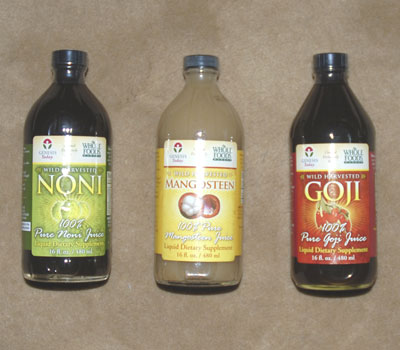
Bottles of sweet to bitter liquids promise the newest cures for all kinds of troubles ranging from impotence to prostate cancer. Multi-level marketers guarantee medical miracles from Goji, Noni and Mangosteen juices without a single mention of the importance of giving up double cheese-bacon-beef burgers or taking a daily walk. Out of this world prices are charged with claims of: 100% organic, kosher, vegetarian, pesticide-free, and chemical-free; high in amino acids, protein, trace minerals, vitamins, anti-oxidants; and containing unique polysaccharides. A single bottle providing one to two weeks' supply will cost you $25 to $50. According to one juice dealer, their company's "mission is to help people become healthier, happier, and richer."1
The mystique surrounding
these juices is enhanced
by their origins in
traditional tribal
medicine.
Goji juice was
discovered by "A doctor
researching an ancient
society deep in the
Himalayan
mountains…considered by
many, to be one of the
most sacred places on
earth.”2
“Noni has
been used in folk
remedies by Polynesians
for over 2000 years, and
is reported to have a
broad range of
therapeutic effects,
including antibacterial,
antiviral, antifungal,
antitumor, antihelminth,
analgesic, hypotensive,
anti-inflammatory and
immune enhancing
effects.”3
“Mangosteen is a fruit
grown in Thailand and
Myanmar… used for many
years in Southeast Asia
as a medicine for skin
infections, wounds, and
diarrhea…”4 |
A Liquid Form of Herbal Medicine?
Plants synthesize substances that can be useful for human health. Worldwide, and throughout history, people have used medicinal plants, commonly referred to as herbs, for an exhaustive range of aliments. In 1000 BC ancient Egyptians considered garlic, opium, castor oil, coriander, mint, and indigo valuable treatments. Today, over half of the effective drugs doctors prescribe have their origin in plants. Familiar examples include: aspirin derived from the willow tree, vincristine (a cancer chemotherapy agent) from the periwinkle plant, digoxin (a powerful heart medicine) from the foxglove plant, and morphine from the opium poppy.
 Juice provides one convenient way to ingest phyto (plant-derived) chemicals. And some juices are definitely effective. One time-honored and proven "natural" way to treat urinary tract infections is by drinking juices made from cranberries and blueberries.5 Chemicals found in these berries inhibit the attachment of bacteria to the lining of the urinary bladder. Most recently, signs of progression of prostate cancer (a PSA rise) in men have been discovered to be slowed with pomegranate juice.6 Active components of plants can also be counterproductive; grapefruit juice for example, interferes with the actions of popular drugs, like statins for cholesterol and blood pressure pills.7 Juice provides one convenient way to ingest phyto (plant-derived) chemicals. And some juices are definitely effective. One time-honored and proven "natural" way to treat urinary tract infections is by drinking juices made from cranberries and blueberries.5 Chemicals found in these berries inhibit the attachment of bacteria to the lining of the urinary bladder. Most recently, signs of progression of prostate cancer (a PSA rise) in men have been discovered to be slowed with pomegranate juice.6 Active components of plants can also be counterproductive; grapefruit juice for example, interferes with the actions of popular drugs, like statins for cholesterol and blood pressure pills.7
One consequence of the explosion of scientific knowledge about plant chemicals has been businesses selling exotic juices. Undoubtedly, Goji, Noni, and Mangosteen juices contain medicinally active phyto-chemicals—just as do juices made from apples, blueberries, cranberries, carrots, pomegranates, and wheat grass at a fraction of the cost. Presently, there is much more scientific research backing up the claims of the inexpensive juices, than there is for the exotic costly ones. To date, research supporting the benefits of Goji, Noni, and Mangosteen juices is sparse and limited to effects observed in cells cultured in the laboratory—without any credible studies on the effects on humans. (Search www.pubmed.gov for up dated information).
The Rising Popularity of Juicing
Juice is an easy, and oftentimes a delicious, way to consume fruits and vegetables. Flavors are enhanced by the sweet-tasting carbohydrates that are released from the fruits and vegetables as they are turned into juices (compare the taste of carrots with that of carrot juice). The grinding and extraction processes also release nutrients from the bound matrix of the fruits and vegetables. These freed-up, biologically active, chemicals are supposed to provide the additional healing powers (over the whole fruit and vegetable) for fixing our ailing bodies. This theory might have value if people living in Western societies needed more nutrients because they suffered from diseases caused by deficiencies, such as beriberi (vitamin B1), pellagra (niacin), or scurvy (vitamin C). But that is not the case. Westerners suffer from diseases of excess—excess fat, protein, cholesterol, salt, sugar, pesticides, etc. Providing more nutrients does not resolve diseases of excess.
Dr. Norman Walker is considered the father of the juicing revolution. He invented the first modern mechanical juicing machine, commonly referred to as a "juicer" in 1930.8 Juicers are often mistaken for blenders. The difference is a juicer separates the pulp from the juice, whereas a blender grinds the substances of the fruits or vegetables all together. Millions of juicers have been sold through infomercials, stores, and the Internet—this is a multibillion-dollar business.
 Damaging a Perfectly Fine Fruit Damaging a Perfectly Fine Fruit
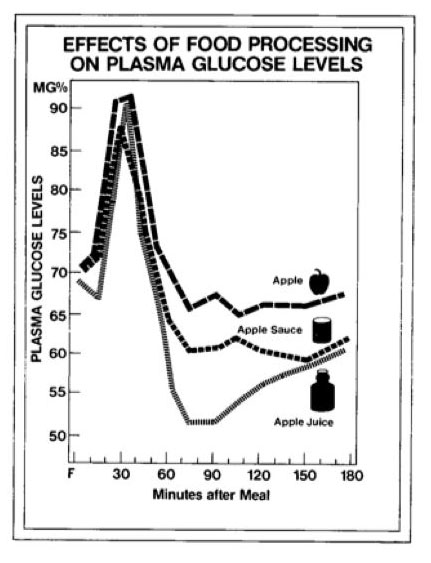
The mashing, grinding, and filtering of fruits and vegetables is not without negative consequences. Research published in 1977 demonstrates how the simple processing of whole foods can have major affects.9 In this experiment ten normal subjects consumed meals based on apples, applesauce, and apple juice. When whole apples are blended into applesauce, nothing is removed, but the natural fibers of the apple are disrupted. To make juice, the fiber is filtered off and discarded. This research found fiber-free juice was consumed eleven times faster than the whole apples and four times faster than the applesauce. Juice was less satisfying to the appetite than was the applesauce and the applesauce was less satisfying than the whole apples. Blood sugar levels rose similarly after all three meals. However, there was a striking fall in blood sugar levels after the juice compared to the applesauce and whole apple. Serum (blood) insulin levels rose much more after the juice and applesauce, than after whole apples. Increased consumption, reduced satiety, and higher insulin levels all promote weight gain—contributing to a person's risk of obesity.
The Whole Food is Healthy, the Parts May Not Be
A diet high in fruits and vegetables is known to prevent obesity, type-2 diabetes, heart disease, cancer and many other common aliments. Over the past century inquisitive scientists have been dissecting these whole foods into their elemental parts in hopes of identifying their exact anti-cancer and anti-heart disease ingredients. Once discovered, the individual plant components, such as vitamins and minerals, are isolated, concentrated, and packaged into pills that are then sold to faithful consumers in the hopes of preventing and fighting diseases. Pills, containing concentrated antioxidants, such as beta-carotene, vitamin C, and vitamin E, have made billions of dollars for supplement industries. Juice dealers also tout the high concentrations of antioxidant vitamins in their products.
Whereas studies of populations of people have found that diets high in fruits and vegetables reduce the risk of cancer and heart disease, taking supplements of antioxidants does the opposite. In one large study, 29,133 male smokers 50 to 69 years of age, from southwestern Finland were assigned to one of four regimes: vitamin E alone, beta-carotene alone, both E and beta-carotene, or placebo. Unexpectedly, an 18 percent higher incidence of lung cancer was found among the men who received beta-carotene, than among those who did not.10 Another study of 18,314 smokers, former smokers, and workers exposed to asbestos found a 17 percent increase in risk of death and a 46 percent increase in lung cancer in those actively treated with a combination of beta-carotene and vitamin A.11 This study also found a 26% increased risk of heart disease in the treated group. The consensus of the scientific community is that whole plant-foods are health-promoting, but taking concentrated nutrients can be harmful.12
Juice Will Not Cure the Ravages Caused by a Rich Diet
Food, through 400 million years of evolution (or, if you choose, by Divine Creation 6000+ years ago), arose to act in perfect harmony with the biologic systems of the human body. The hosts (us) and the fuel are extremely complex living tissues and interact in mysterious, but perfectly correct ways. 13 Any alteration of the food will interfere with the exactness of this complicated interaction.
Undoubtedly, the foundation of our health comes from a whole plant-food (starch-based) diet, moderate exercise and sunshine, clean water and air, and surroundings that support psychological comfort. If any of these ingredients are wrong—as typically found among people living in Western societies—then disease easily develops. Witness, almost every person over age 30 is overweight and/or on medication. Juices, even exotic and expensive ones, will not correct fundamental problems. Juice is no longer a whole plant-food and the consequence on human health of consuming large amounts of this alteration of whole fruits and vegetables is yet to be determined. At the very least, consuming any kinds of juices, rather than the whole food, will promote weight gain.14,15 In the case of exotic juices, the verdict, based on present evidence, is the financial costs outweigh any demonstrated benefits.
References:
1) (http://www.myvemma.com/chorton?gclid=CPOD7PHhwZACFQMxiQodkyxIPA)
2) http://www.gojiwholesale.com
3) http://www.raysahelian.com/noni.html
4) http://www.raysahelian.com/mangosteen.html
5) Jepson RG, Craig JC. A systematic review of the evidence for cranberries and blueberries in UTI prevention. Mol Nutr Food Res. 2007 Jun;51(6):738-45.
6) Pantuck AJ, Leppert JT, Zomorodian N, Aronson W, Hong J, Barnard RJ, Seeram N, Liker H, Wang H, Elashoff R, Heber D, Aviram M, Ignarro L, Belldegrun A. Phase II Study of Pomegranate Juice for Men with Rising Prostate-Specific Antigen following Surgery or Radiation for Prostate Cancer. Clin Cancer Res. 2006 Jul 1;12(13):4018-4026.
7) Kirby BJ, Unadkat JD. Grapefruit juice, a glass full of drug interactions? Clin Pharmacol Ther. 2007 May;81(5):631-3.
8) http://books.google.com/books?id=xzQ7Gl8hiUYC&pg=PT31&lpg=
PT31&dq=history+of+juicing&source=web&ots=pXzg00dFEV&sig
=dWaFLMV5G9HsoGPVBpi3syW6ius#PPT44,M1)
9 Haber GB, Heaton KW, Murphy D, Burroughs LF. Depletion and disruption of dietary fibre. Effects on satiety, plasma-glucose, and serum-insulin. Lancet. 1977 Oct 1;2(8040):679-82.
10) The effect of vitamin E and beta carotene on the incidence of lung cancer and other cancers in male smokers. The Alpha-Tocopherol, Beta Carotene Cancer Prevention Study Group. N Engl J Med. 1994 Apr 14;330(15):1029-35.
11) Omenn GS, Goodman GE, Thornquist MD, Balmes J, Cullen MR, Glass A, Keogh JP, Meyskens FL, Valanis B, Williams JH, Barnhart S, Hammar S. Effects of a combination of beta carotene and vitamin A on lung cancer and cardiovascular disease. N Engl J Med. 1996 May 2;334(18):1150-5.
12) McCormick DB. The dubious use of vitamin-mineral supplements in relation to cardiovascular disease. Am J Clin Nutr. 2006 Oct;84(4):680-1.
13) Jacobs DR Jr, Tapsell LC. Food, not nutrients, is the fundamental unit in nutrition. Nutr Rev. 2007 Oct;65(10):439-50.
14) Pattern of beverage consumption and long-term association with body-weight status in German adolescents - results from the DONALD study. Br J Nutr. 2007 Nov 23;:1-10.
15) Faith MS, Dennison BA, Edmunds LS, Stratton HH. Fruit juice intake predicts increased adiposity gain in children from low-income families: weight status-by-environment interaction. Pediatrics. 2006 Nov;118(5):2066-75. |